How to Deconstruct the Flavor Structure of a Cigarette Through "Nasal Olfaction + Oral Cavity"
April 12, 2024, 9:40 PM — I sat at my rented-room desk for a "slow deconstruction." On the table were only one regular-tar blended sample, a glass of room-temperature water, a phone timer, and a pre-printed blank record sheet. The air conditioner was off, the window left a finger-width gap; the hygrometer showed 24.1 °C, relative humidity about 48 %. I deliberately avoided coffee 40 minutes before starting, and didn't brush my teeth — the mint in toothpaste would have masked the first 10 minutes of cold aroma entirely with a "cooling sensation." That was a mistake I made in Hangzhou in the winter of 2022 during a group smoking session: three people smoking in rotation with sugar-free mint candies in their mouths, and the next day's notes all read "refreshing, clean." Only after listening back to the recording did I realize no one had actually smelled the tobacco's inherent bean-like aroma.
That night, I wanted to verify only one thing: If I record the same cigarette separately — pre-nasal olfaction, retro-nasal olfaction, and oral retention — would it yield three more layers of repeatable structure than just "tastes good." The results went into my notebook: for the top note I wrote "sweet-toasted 2, woody 1, slight green off-note 1"; mid-section after nasal exhale became "nutty 3, sweet-toasted 2, throat dryness irritation 2"; after 2 minutes the aftertaste was just a thin bitterness at the tongue root and a very faint cocoa-skin scent in the nasal cavity. Three stages were not the same face. Since then, I've made "nasal olfaction + oral cavity" a fixed procedure, not a performance done when in the mood.
Let's nail down the boundaries first, so the subsequent steps hold:
- **Understanding structure does not reduce health risks.** A clear aroma and clean aftertaste do not equal greater safety. Combustible tobacco products still carry nicotine dependence and multiple harmful exposures.
- **This article teaches observation and recording, not smoking more or longer.** If you are quitting or don't smoke, practice vocabulary using reference items (almonds, wood strips, coffee beans) without lighting a cigarette.
- **Physical state rewrites results.** Nasal congestion, perfume, a recent hotpot meal, more than 4–5 cigarettes in a continuous session, or someone spraying air freshener in the room will invalidate your record.
- **Vocabulary is convention, not a literary contest.** "Like a rainy highland road" cannot be aligned; "mid-section woody 3, retro-nasal nutty 2, tongue-root slight bitter 2, aftertaste 3 minutes still dry" can.
I. Why Most People "Know How to Smoke" but "Can't Deconstruct Structure"
In industry evaluation, common dimensions include aroma, harmony, off-notes, irritation, aftertaste, etc. Public materials and textbooks also distinguish global sensory evaluation from local sensory evaluation — the latter often emphasizes holding the smoke in the mouth for about 2–4 seconds before exhaling slowly through the nose, rather than inhaling deeply into the lungs and recording only a single "hit." Consumer-side conversations, however, often collapse into three phrases: smooth or harsh, strong or mild, expensive or cheap.
My view is clear: The first puff is the most deceptive, the mid-section is the most honest, and the aftertaste reveals the most about craftsmanship and condition. In August 2023, during an informal comparison in Guangzhou, Sample A delivered a pleasant honey-sweetness for the first 30 seconds after lighting — all four people at the table nodded. By the 6th–8th puff, retro-nasal olfaction began to reveal a wet-cardboard off-note, and the lateral edges of the oral cavity felt increasing astringency. If you only recorded the opening, you'd give Sample A a high score. If you forced yourself to write "mid-section + nasal exhale + 2-minute aftertaste," the score would drop significantly. That's not "the palate got pickier"; it's that the information channels opened.
Flavor is not a single sense. It can be roughly broken down as:
| Channel | Main Contribution | What You're Actually Recording |
|---|---|---|
| --------- | ------------------ | ------------------------------- |
| **Pre-nasal olfaction** (unlit/near the cigarette) | Volatile aroma, casing aroma, box note, green off-note | Cold aroma skeleton |
| **Retro-nasal olfaction** (smoke held in the mouth then exhaled through the nose) | Main body and layers of aroma — much of what's called "tobacco fragrance" is actually established here | Smoke aroma structure |
| **Oral taste** | Sweet, bitter, sour, etc. basic tastes | Flavor base |
| **Chemesthetic sensation** | Irritation, heat, astringency, dryness, numbness | Impact and irritation points |
| **Timeline** | First puffs / mid-section / final third / post-smoking | Whether structure collapses, whether post-bitter appears |
Many people mistake "low irritation" for "good aroma" and "strong nicotine impact" for "rich flavor." The first step of deconstruction is to allow these dimensions to score separately, and not let a single word "comfortable" swallow everything.
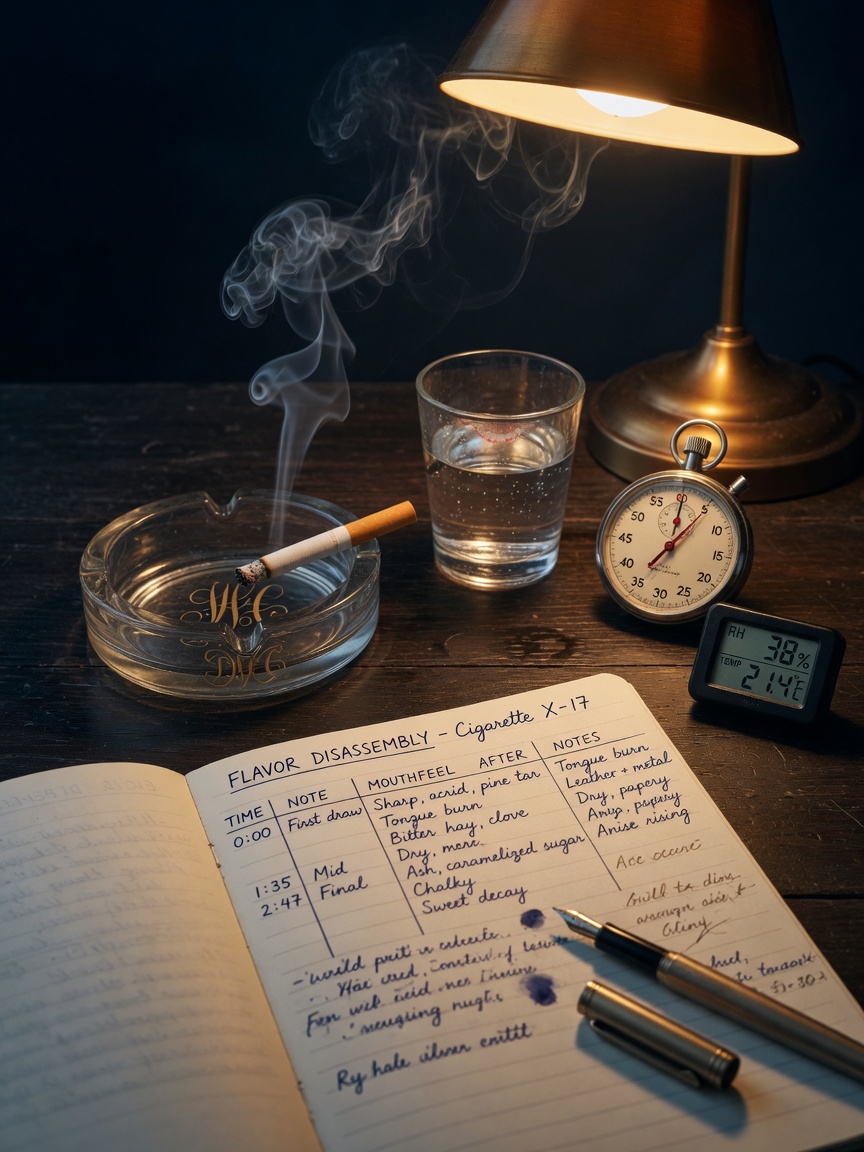
II. The "Four-Layer Flavor Structure Model" I Advocate
You don't need to memorize chemical formulas. You just need a skeleton you can fill into a table. This is the system I've been using, barely changed since 2024:
1. Cold Aroma Skeleton (Before Lighting)
Within 3–5 seconds after opening the pack, sniff the tobacco/ filter end from close range (don't press your nose against it and inhale dust). Ask yourself: sweet-toasted, grassy, milky, wooden box, papery, or nearly odorless? The cold aroma determines "expectation," and also reveals storage problems — humidity, dryness, or cross-contamination often alarm you here first.
2. Smoke Timeline (After Lighting)
- **Top note (approx. 1st–3rd puff):** Lighter flavor, paper taste, instant sweetness, first wave of irritation.
- **Mid-section (stable burn phase):** The true aroma and harmony zone — recommended for focused retro-nasal recording.
- **Final third (end segment):** Whether it turns charred, harsh, hollow, or shows off-notes.
3. Oral Texture Framework
Impact (intensity), smoothness/roughness, dryness/moisture, astringency, tongue placement (tip/sides/root/soft palate). Oral texture can fight with aroma: beautiful aroma but dry and bitter tongue root means "aroma score high, flavor score low."
4. Aftertaste Residue
30 seconds, 2 minutes, 5 minutes after the smoke leaves: clean or coated? Returning sweetness or post-bitter? Does the nasal cavity still carry a certain type of aroma? In industry contexts, aftertaste is often discussed in terms of comfort, cleanliness, dryness, etc. You don't need to score like the industry, but cultivate the habit of watching the clock.
Intensity scale (recommended unified): Each attribute 0–5.
0 = absent; 1 = faint; 2 = definite but weak; 3 = clear dominant note; 4 = prominent; 5 = overwhelming everything else.
The same cigarette can have "sweet-toasted 3 + off-note 2 + irritation 3" — this is ten times more useful than "overall 8.5 points."
III. Operational Procedure: A Complete "Nasal + Oral" Deconstruction
Below is written according to my actual actions on that April 2024 night. You can compress it into an 8-minute version, but do not remove retro-nasal olfaction and aftertaste timing — remove those two, and the method in the article title becomes invalid.
Step 0: Environment and Personal State (2 minutes)
- Room has no noticeable perfume, cooking oil, or incense. Relative humidity should not be so low that it stings the nasal mucosa (in my own experience during heating season with RH < 35%, dryness scores were inflated).
- Avoid coffee, spicy food, mint candies, and gum for 30–60 minutes before evaluation.
- If the nose is congested, try another day, or do only cold sniffing + reference training.
- Preparation: plain water, tissue, timer, record sheet (paper and pen are less likely to make you "scroll while smoking").
- **Seriously deconstruct only 1 cigarette at a time**; for comparison, add at most 1 more, with plain water and quiet breathing for 5 minutes in between. From the third consecutive cigarette onward, my nutty/floral resolution noticeably drops — after evaluating 6 in a row in Shanghai in 2021, my notes were filled with "kind of smells good," pure olfactory fatigue.
Step 1: Lock Down Sample Information First (1 minute)
Brand/type (Virginia, blended, etc.), labeled tar and nicotine (if any), purchase/production approximate time, storage method (original pack, cigarette case, refrigerated?).
Personal view: Notes that don't record storage conditions become uninterpretable three months later — "why was the woodiness so strong this time?" It could be the cedar box, not the tobacco.
Step 2: Cold Sniff (Pre-nasal Olfaction, 30–60 seconds)
- Gently tap the cigarette, observe the appearance outside the burning section — no need for theatrical examination.
- About 2–3 cm from the tobacco end, inhale naturally twice, eyes closed.
- Force yourself to write **3 words + intensity scores**, do not write "cigarette smell."
- If the first reaction is "box smell / paper smell," list it on a separate line, don't merge it with leaf aroma.
Problems I've encountered: January 2023, Beijing, indoor heating strong, RH about 28%. Cold sniff was all dry hay pungency, but the mid-section after lighting was okay. Later, I fixed "ambient humidity" at the top of the note page, reducing misjudgments of "this cigarette has heavy green off-note."
Step 3: Light and First 3 Puffs (Record Only, Don't Jump to Conclusions)
- Light evenly to avoid single-side charring.
- 1st puff: record lighter flavor, paper taste, whether the impact hits the nose.
- 2nd–3rd puffs: hold smoke in the mouth for about **2–3 seconds** (no need to obsess over the stopwatch, but don't "inhale and blow out immediately" or hold too long).
- Focus this segment on: **first irritation landing point** — nasal alae, throat, or tongue root.
Step 4: Mid-Section Main Evaluation — Oral Retention + Nasal Exhale (Core)
This is the heart of the entire method.
- Take a moderate mouthful (don't gulp for "intensity").
- Hold smoke in the mouth for about 2–4 seconds, lightly touch with the tongue tip, then let the smoke move toward the soft palate — no need to exaggerate puffing.
- **Exhale slowly through the nose**, eyes can be slightly closed, focus on retro-nasal olfaction.
- Immediately write in two columns on the sheet:
- **Oral column**: sweet/bitter/dry/astringent/oily + score;
- **Retro-nasal column**: sweet-toasted, nutty, woody, milky, floral, green off-note, dusty, burnt, etc. + score.
- Repeat 2–3 rounds to check for stability. If each round is different, first check if you're puffing too fast or if the cigarette went out and was re-lit.
Why must you exhale through the nose?
Many sensations advertised as "rich tobacco aroma" actually work through the retro-nasal pathway. If the smoke only goes through the mouth and is quickly spat out, you're more likely to be left with just irritation and bitterness — the structure flattens. Public evaluation method discussions also repeatedly describe the path of "hold in mouth then exhale through nose." You can understand it as: giving the aroma a chance to reach the olfactory zone, not just fight it out on the tongue surface.
Flip record: In summer 2022, trying to "smell more," I held the smoke for nearly 6–7 seconds; the result was that irritation and bitterness were amplified, and the nutty score was inflated to "burnt." After that, I set the mental upper limit at about 4 seconds, and if I exceeded it, I'd mark "operation error."
Step 5: Impact and Irritation — Separate Accounting
- **Impact (body):** Whether the head is light or not, how fast the satisfaction comes (this is physiological impact, not an aroma score).
- **Irritation:** Stinging in the front of the nasal cavity, scratchiness in the throat, numbness on the tongue surface, or discomfort in the upper chest — write the landing point, not a useless phrase like "a bit irritating."
- **Off-notes:** Green, raw-fishy, dusty, plastic-like, excessive char. Off-notes can coexist with aroma; when harmony is poor, it's often because off-notes rise in the mid-section.
Step 6: Final Third and Extinguishing
Is the charring obvious in the later section? Does it need frequent re-lighting? Is the ash wrapped?
These affect more of the "burn stability" judgment. I personally write "final third char +2" directly into the negative, rather than averaging it out with the top note's honey-sweetness.
Step 7: Aftertaste Timeline (Must Watch the Clock)
| Time Point | Question to Ask |
|---|---|
| ------------ | ----------------- |
| **30 s after** | What still lingers in the mouth? Sweet, bitter, sour, metallic? |
| **2 min** | Any residual aroma in the nasal cavity? Has dryness worsened? |
| **5 min** | Mostly clean, or like a thin coating stuck to the tongue root? |
Take a small sip of plain water, then ask again: did the water turn sweet/bitter? Some use this to judge "return sweetness," but don't mythologize it — water temperature and whether you just ate something will both interfere.
Step 8: One-Sentence Structural Conclusion + One Hypothesis to Verify
For example:
"Cold aroma sweet-toasted weak; mid-section retro-nasal nutty 3 / woody 2; oral cavity dry irritation 3; aftertaste 2 minutes tongue root bitter. Hypothesis: dry storage inflated dryness score; try re-testing after 48-hour equilibration at RH ≈ 55 %."
A record without a hypothesis is just a diary. A record with a hypothesis forms your own tasting vocabulary.
IV. Record Template (Ready to Copy)
[SAMPLE] Name/Type:
Labeled tar/nicotine (if any):
Purchase & storage:
Evaluation date/time:
Environment: Temp__ °C   RH__ %   Other odors: yes/no
Personal state: Nose clear? Diet/brushing/coffee in past hour:

[COLD AROMA·Pre-nasal] Word1(__) Word2(__) Word3(__)
Box/paper/cross-contamination:

[TOP 1–3 PUFFS] Aroma:        Irritation landing:        Notes:

[MID·Oral] Sweet__ Bitter__ Dry__ Moist__ Astringent__ Other:
[MID·Retro-nasal] Sweet-toasted__ Nutty__ Woody__ Milky__ Floral__ Green__ Burnt__ Other:
Harmony (1–5):     Off-notes (0–5):

[BODY 0–5]    [Overall Irritation 0–5] Landing:

[FINAL THIRD] Changes:

[AFTERTASTE] 30s:        2min:        5min:
After water:

[ONE-SENTENCE STRUCTURE]
[HYPOTHESIS TO VERIFY]
[OPERATION ERRORS] Puffing too fast/re-light/held too long/environment interference: yes/no
Intensity unified 0–5. Better to leave blank than to fabricate; fabricated words are the poison of tasting vocabulary.
V. How to Build "Your Own" Tasting Vocabulary (Instead of Memorizing Advertising Slogans)
1. Reference Desktop Training (No Need to Light a Cigarette)
I did one round in November 2023 and still recommend reviewing once a month, 15 minutes each session:
| Target Word | Reference Example |
|---|---|
| ------------- | ------------------- |
| Woody | Unvarnished cedar strip, pencil shavings |
| Nutty | Lightly roasted almonds, compare with raw almonds |
| Sweet-toasted | Caramel edge, lightly sniffed roasted coffee beans |
| Milky/creamy | A small spoonful of light cream |
| Green/grassy | Split green vegetable stem, dried hay (mind hygiene) |
| Dusty/earthy | Potting soil (lightly touch with a damp tissue then sniff) |
First sniff the reference, then recall your last mid-section retro-nasal note, and do a "forced replacement": replace "elegant, comfortable, layered, complex" with attribute + intensity + position (cold aroma/mid-section/aftertaste).
2. Banned Vague Word List (Post Above Your Record Sheet)
- Smells nice / Not bad / Premium feel / Very flavorful
- Rich in layers (unless you can list at least two different attributes from different time segments)
- Good mouthfeel (break it down into dry, moist, irritation landing, bitter)
3. Cross-Examination Between the Two Channels
Trusting only retro-nasal olfaction ignores tongue-root bitterness and dryness; trusting only the oral cavity mistakes low irritation for good aroma.
My fixed cross-examination sentence: "If I split the aroma score and the flavor score, which one is carrying the weight?"
In June 2024, a sample had retro-nasal nutty 4, but aftertaste at 5 minutes was still dry-bitter 3 — my structural comment was "aroma has a lead, flavor drags behind," not "overall decent." That kind of sentence is your own vocabulary.
4. Practice Frequency
- Serious deconstruction: once a week is enough; chain-smoking for practice drops resolution.
- Reference training: 1–2 times per month.
- Same cigarette, repeat deconstruction: try again after two weeks to see if your words are stable. Stable means your vocabulary is forming; wild fluctuations — first check environment and body state.
VI. Common Questions and My Direct Answers
Q: Do I have to inhale the smoke?
During structural deconstruction, I more often use the "oral retention + slow nasal exhale" pathway, focusing on aroma and oral sensation. Deep lung inhalation amplifies nicotine impact and health costs; it's not necessary for "aroma vocabulary training." Don't imitate more harmful methods for the sake of appearing "professional."
Q: Can this system be used for e-cigarettes / heated tobacco?
The channel logic is universal (pre-nasal/retro-nasal/oral/aftertaste), but the pyrolysis and temperature curves differ, and the sources of burnt taste and sweetness are also different. The table can be shared, but don't force a direct comparison between conclusions of "which is more premium."
Q: What if I don't have a hygrometer?
At least record the season, whether AC/heating is on, and whether the nose feels dry. Numbers are better, but if you don't have numbers, write a replicable environmental description.
Q: Could recording make me want to smoke more?
It's possible. If you find yourself using "evaluation" to increase consumption, stop immediately, switch back to reference training, or change your goal to cessation records. The method is a tool, not a license.
VII. Turning the Method into a Habit: 8-Minute Extremely Simplified Version
When time is tight, I use only this page:
- Write environment + personal state (30 s)
- Cold aroma 3 words (30 s)
- Mid-section two rounds: oral score + retro-nasal score (4 min)
- Aftertaste 2-minute check once (2 min)
- One-sentence structure + one hypothesis (1 min)
Eight minutes won't finish a novel, but it will finish a structure. On that April 2024 night, the full version took me nearly 25 minutes. Later I realized that what truly changed my judgment was not having more adjectives, but the forced inclusion of mid-section retro-nasal olfaction and 2-minute aftertaste. Without these two columns, I'd fall back to the lazy conclusion of "first puff is sweet."
Let me state my position one last time: The value of tasting vocabulary is to help you see what sensations you're paying for and what stimulation you're addicted to — not to find an aesthetic excuse for combustion. If you can deconstruct "sweet-toasted 3 / dry 3 / aftertaste bitter 2," you'll find it easier one day to decide whether these scores are still worth trading your body for.
If you're ready to start, don't buy new cigarettes first. Print one page of the template, find a dry, fragrance-free evening, and seriously complete one round of mid-section retro-nasal olfaction and aftertaste timing. A first slightly clumsy record is closer to real tasting than ten sentences of "rich in layers."